

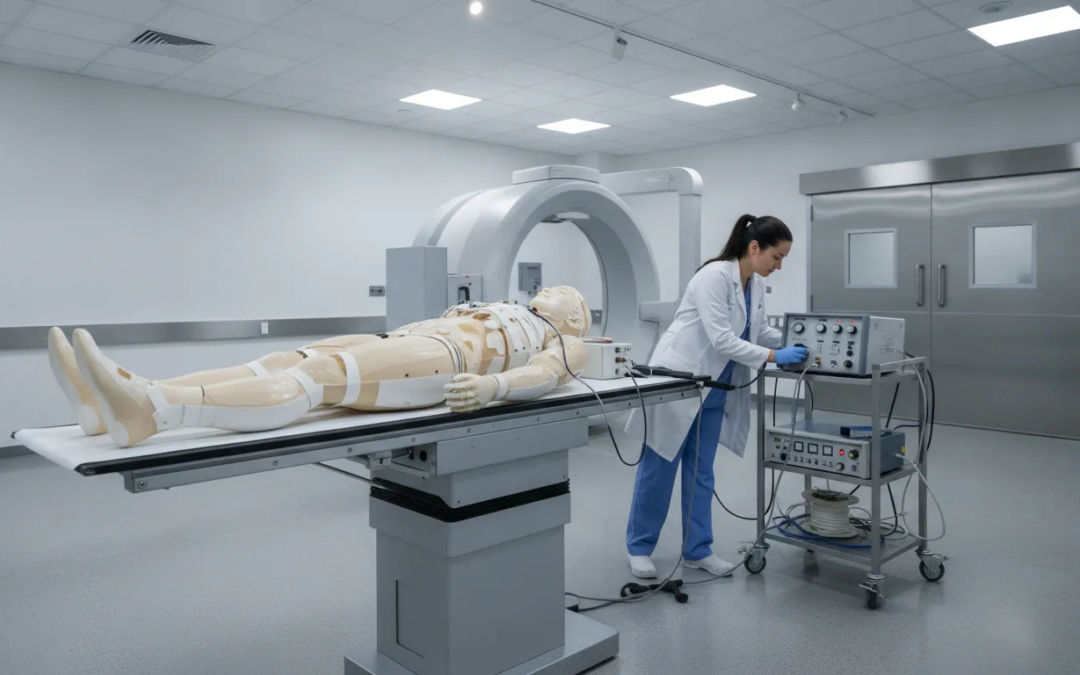
Alderson Phantom: From Crash Tests to Medical Physics
A crash-test dummy and a radiation-therapy phantom may seem to belong to different fields. Their shared foundation is anthropomorphic modeling: building a test object that represents the human body closely enough to make measurements, comparisons, and safety decisions more meaningful. Samuel W. Alderson applied that principle across automotive safety, aerospace engineering, and medical physics.
The Alderson phantom brought human-shaped modeling into radiation-treatment research by giving physicists a repeatable way to study dose distribution and treatment-planning questions in an anatomically representative form. That connection grew from Alderson’s earlier work on devices such as Sierra Sam and his broader engineering approach, not from a simple rebranding of a crash-test dummy.
Radiology Support Devices Inc., now RSD Phantoms, traces its heritage to this work and continues to support institutional teams through custom, quote-based solutions. If your project has a specific imaging, dosimetry, education, or quality-assurance need, you can request a quote for product-specific guidance. First, it helps to understand the physicist and inventor behind the design.
Who Was Samuel W. Alderson, the Mind Behind the Alderson Phantom?
Samuel W. Alderson was more than the inventor commonly associated with the automotive crash-test dummy. He was a physicist, engineer, and pioneer in the design of anthropomorphic test devices: physical models built to represent the human body in demanding technical tests. That work required more than a human-shaped form. It required careful attention to anatomy, motion, materials, and the way a model responds to forces or energy.
In the early 1950s, Alderson developed Sierra Sam for aircraft ejection-seat testing. He also engineered life-like dummies for NASA Apollo water-landing safety. These aerospace applications established a practical design philosophy: a test device should represent relevant human characteristics closely enough to produce useful, repeatable information. His career therefore connected engineering design with safety research across transportation and aerospace.
That same anthropomorphic approach later informed medical physics. Alderson created the RANDO phantom to help guide radiation treatments for cancer, connecting a history of human-representative test devices with the needs of treatment planning and dosimetry. The shift was not a simple conversion from a crash-test dummy into a medical product. It was an application of related engineering principles to a different technical question: how can researchers and clinical teams evaluate radiation behavior in a model that represents the human body?
This history is central to understanding what the phrase Alderson phantom means. It describes a legacy of using anatomically informed models to support measurement, research, education, and quality assurance. It does not mean that Alderson invented medical physics, nor does it reduce his work to one automotive application. His influence spans aerospace safety, anthropomorphic test-device engineering, and radiation-therapy phantom development. For a concise account of the company and technology’s origins, see the RSD Phantoms history.
Radiology Support Devices Inc., now known as RSD Phantoms, traces its heritage to this work beginning in 1951. The historical throughline matters because modern phantom design still depends on the central problem Alderson addressed: creating a physical. Repeatable representation of human anatomy for carefully defined technical testing.
From Crash-Test Dummies to Radiation Therapy
The connection between an automotive crash-test dummy and a radiation-therapy phantom is not that the two devices serve the same purpose. It is that both use anthropomorphic modeling to make complex physical interactions measurable under controlled conditions. A human-shaped model can provide a repeatable geometry for studying how energy moves through, around, and beyond the body, without presenting a patient as a test object.
Samuel W. Alderson’s work with anthropomorphic test devices established a practical foundation for this kind of modeling. After developing Sierra Sam for aircraft ejection-seat testing and life-like dummies for NASA Apollo water-landing safety, Alderson applied related engineering thinking to medical physics. He created the RANDO phantom to support research connected with cancer radiation treatments. The result was a bridge between human-form simulation and questions about attenuation, dose distribution, treatment planning, and delivery verification. Radiation therapy phantoms remain useful precisely because they make those questions testable and repeatable.
Why anthropomorphic geometry matters in dosimetry
Radiation does not interact with a featureless block in the same way it interacts with a torso containing different tissue densities, cavities, and organs. An anthropomorphic phantom gives medical physicists a physical model in which detectors can be positioned at defined locations and measurements can be compared with calculations or treatment-planning-system results. The phantom does not diagnose or treat cancer. Instead, it supports controlled evaluation of plans, techniques, and measurement methods.
That role is illustrated by a 2022 study using an Alderson Rando phantom to measure planning-target and organ-at-risk doses across 3D conformal, IMRT, VMAT, and hybrid treatment plans. Researchers measured dose at 23 locations with optically stimulated luminescence dosimeters and EBT3 films, then compared measurements with the treatment planning system. The study reported maximum differences of 1.7 percent for OSLD and 6.15 percent for film in the stated comparisons. It concluded that both methods were suitable for dose measurement with the Rando phantom (medical physics study).
Other academic work has used Rando phantoms to examine out-of-field doses in breast radiotherapy and an anthropomorphic Alderson phantom to study exposure from mobile 3D C-arm imaging. Together, these applications show the enduring concept: realistic anatomy turns abstract radiation behavior into evidence that teams can measure, compare, and improve.
How the RANDO Phantom Changed Medical Physics Practice
The RANDO phantom gave medical physicists a practical way to study radiation dose in an anatomical context. It reduced reliance on abstract points alone. Its human-shaped form helped connect treatment geometry, tissue attenuation, organ location, and measurement technique in a repeatable test object. That shift mattered because a phantom can be positioned, measured, and remeasured under controlled conditions while preserving a consistent anatomical reference.
In radiation therapy, repeatability supports more than a single dose reading. It allows teams to compare treatment-planning approaches, examine dose outside the intended field, and investigate how planning assumptions translate into delivered dose. RSD describes the later Alderson Radiation Therapy Phantom as a refined version of the Alderson RANDO Phantom, designed to support integrated tests across treatment planning and delivery. That historical and technical continuity is documented on the Alderson radiation therapy phantom product page, while the broader RANDO legacy remains the focus here.
From dosimetry to treatment-planning verification
Academic studies show how researchers have used the RANDO platform to test questions that require both realistic anatomy and controlled measurement. A 2022 study of left-breast radiotherapy used an Alderson Rando phantom to measure planning-target-volume and organ-at-risk doses across 11 combinations of three-dimensional conformal radiotherapy. IMRT, VMAT, and hybrid techniques. Researchers measured 23 locations with optically stimulated luminescence dosimeters and EBT3 films. The study reported a maximum film deviation of 6.15 percent against the treatment-planning system and a maximum OSLD difference of 1.7 percent. It concluded that both methods were suitable for dose measurement with the Rando phantom. Read the 2022 study.
That evidence illustrates the value of a stable anatomical test environment. The question is not simply whether a treatment plan produces a calculated dose, but how measurement methods compare with the planning system under defined conditions. Other published work has used Rando phantoms with thermoluminescent dosimeters to evaluate out-of-field breast-radiotherapy exposure. Another study used an anthropomorphic Alderson phantom to study radiation exposure from mobile three-dimensional C-arm imaging. Together, these applications place the phantom within a larger quality-assurance practice, where repeatable measurements support method comparison. Equipment evaluation, and training without presenting the model as a substitute for clinical judgment or patient care.
What Alderson’s Legacy Means for Modern Phantom Design
The lasting value of the Alderson phantom is not limited to its historical identity. Its deeper contribution is a design approach: represent relevant human anatomy closely enough to make testing meaningful, while building the model so measurements and observations can be repeated. That principle remains useful as medical physicists work across imaging, radiation therapy, nuclear medicine, health physics, education, quality assurance, and research.
Modern phantom design therefore begins with the use case. A model intended for treatment-planning and delivery QA may need anatomical structures and measurement access suited to dosimetry. An imaging phantom may prioritize controlled attenuation, contrast, geometry, or image-quality assessment. A teaching phantom may emphasize visibility, explanation, and safe handling. The common thread is not that one phantom can serve every purpose, but that the anatomy, materials, motion, and measurement features should match the question being studied.
| Use case. | Typical design priority. | What teams evaluate. |
|---|---|---|
| Radiation therapy QA. | Anatomy and detector access. | Dose, planning, and delivery measurements. |
| Diagnostic imaging. | Geometry and controlled attenuation. | Image quality and protocol performance. |
| Education and training. | Visibility and safe handling. | Positioning, anatomy, and workflow understanding. |
| Research. | Defined, repeatable configuration. | Methods, devices, or protocols under study. |
Anatomical representation with a defined purpose
That distinction also explains why customization matters. Medical-physics teams may need a particular body region, modality combination, motion pattern, or measurement workflow. RSD Phantoms produces custom-made devices in the USA using molding, 3D printing, and advanced modeling. This allows the design conversation to begin with the technical requirement rather than a generic shape. The company describes its portfolio as serving institutional work in diagnostics, therapy, education, QA, and research, each with different performance priorities.
For example, a dynamic anthropomorphic thorax addresses the role of respiratory motion in a defined imaging or therapy workflow. A multi-modality fusion head phantom reflects the need to compare or align information across imaging modalities. These products extend the anthropomorphic idea into more specialized test environments rather than treating anatomy as decoration.
Materials and claims must remain product-specific
Material selection is equally important. RSD documentation describes tissue-equivalent materials and ICRU-44 alignment for specific ART Phantom documentation. Those statements should not be generalized to every product in the catalog.
The same disciplined approach applies to education. The Take-Apart Pixy has served radiological technologist teaching and training for more than 30 years, but its educational role is distinct from a dosimetry phantom’s QA function. Alderson’s legacy is strongest when modern designs preserve that clarity, linking anatomical fidelity and repeatability to a defined technical purpose.
Continuing the Alderson Legacy at RSD Phantoms Today
Today, Radiology Support Devices Inc. carries the Alderson tradition forward through anthropomorphic phantoms designed for real medical-physics environments. RSD Phantoms continues to manufacture products in the USA, combining molding, 3D printing, and advanced modeling with a consultative approach to customization. The goal is not to preserve a historical object unchanged. It is to apply the underlying value of anthropomorphic modeling, a physical test object that represents relevant anatomy, to the technical questions institutions need to answer now.
That work spans diagnostic radiology, radiation therapy, nuclear medicine, health physics, education, quality assurance, and research. Across these settings, a phantom can provide a repeatable subject for imaging evaluation, dose measurement, treatment-planning studies, training, or system verification. The appropriate design depends on the modality, anatomy, measurement method, and intended workflow. RSD’s broad portfolio reflects that distinction rather than treating one phantom as a universal solution.
From heritage to application-specific design
The connection to the Alderson phantom is especially direct in radiation therapy. RSD describes its Alderson Radiation Therapy Phantom as a refined version of the Alderson RANDO Phantom. Documented design and material improvements support integrated tests of treatment planning and delivery. Those product-specific details belong to the product documentation.
The larger legacy is the design discipline behind them: represent anatomy clearly, create access for measurement, and make testing repeatable.
The same principle supports education and quality assurance. RSD reports approximately 10,000 phantoms deployed worldwide, and its Take-Apart Pixy has served teaching and training needs for radiological technologists for more than 30 years. To understand how that heritage informs current capabilities, explore RSD Phantoms expertise.
If your institution needs an anthropomorphic phantom for a specific modality, measurement strategy, training program, or research question, share the application requirements with the team through a Request a Quote. A product-specific conversation can clarify the relevant anatomy, materials, configuration, and intended use before a recommendation is made.
Frequently Asked Questions
What is an Alderson phantom used for?
An Alderson phantom is an anthropomorphic model used to represent human anatomy in medical-physics testing. Depending on its design, it can support radiation-therapy dosimetry, treatment-planning evaluation, imaging research, education, and quality assurance. It provides a repeatable physical test object for studying dose or image behavior without using a patient.
How did the RANDO phantom connect Alderson’s work to medical physics?
Samuel W. Alderson applied his experience with life-like test devices to the development of the RANDO phantom for radiation-treatment applications. That work extended anthropomorphic modeling from safety testing into a medical-physics setting, where anatomy and measurement conditions could be reproduced for research and treatment-system evaluation. See the documented history at RSD Phantoms history.
What is the difference between a RANDO phantom and an ART Phantom?
RANDO refers to the earlier Alderson radiation-therapy phantom associated with this historical development. The Alderson Radiation Therapy, or ART, Phantom is described by RSD Phantoms as a refined version with updated design and materials. Its documented use includes integrated testing of treatment planning and delivery, while its tissue-equivalent material claims apply specifically to that product.
Can an Alderson phantom be used for imaging as well as radiation therapy?
Yes. Anthropomorphic phantoms can be designed for different modalities and measurement objectives, including diagnostic imaging, radiation therapy, nuclear medicine, health physics, and education. The appropriate model depends on the anatomy, modality, detectors, and test protocol involved. Product-specific capabilities should be confirmed with the manufacturer before selecting a phantom for a particular study or QA program.
Explore the Alderson Legacy with RSD Phantoms
An Alderson phantom can be a useful starting point for teams evaluating anthropomorphic models, historical continuity, or a customized medical physics application. To discuss an Alderson phantom or a tailored solution, request a quote and share your technical goals with the RSD Phantoms team.